SN81 miner burn up to 91%
The subnet now routes 91% of its miner emission to burn (was 76%). Miners earn little or nothing from it while this lasts.
Detected 11h agoView subnet →
Subnet teams' own channels, X posts, press, newsletters and events read from the chain — GitHub lives in its own tab
The subnet now routes 91% of its miner emission to burn (was 76%). Miners earn little or nothing from it while this lasts.
Detected 11h agoView subnet →
The subnet burns 76% of its miner emission now (was 92%): miners are being paid again.
Detected 1d agoView subnet →
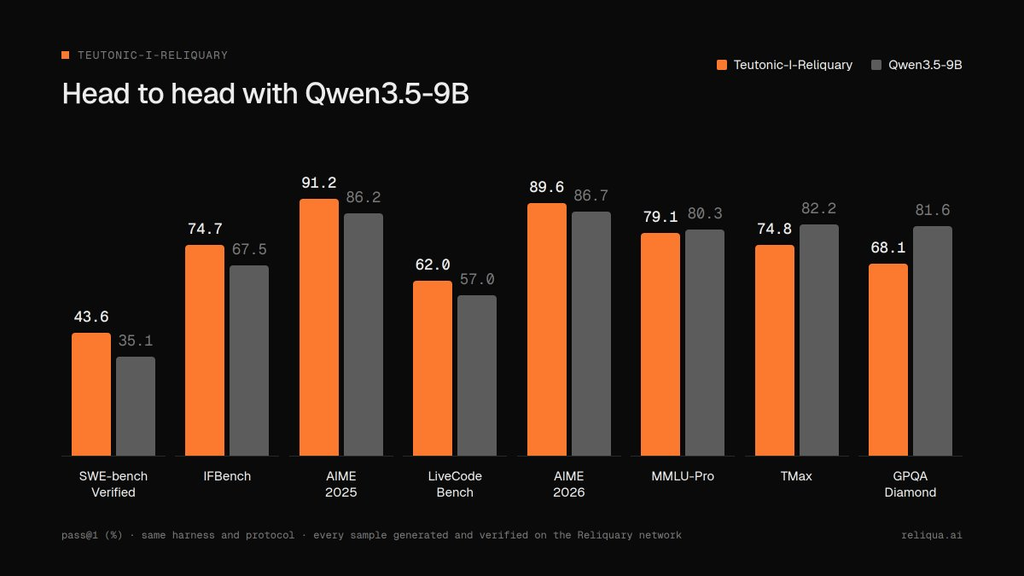
Reliquary post-trained Teutonic-I-Reliquary with 161 miners. The 9B model beat Qwen3.5-9B on five of eight benchmarks and scored 43.6% on SWE-bench Verified. [...] The post Reliquary (SN81) Post-Trained a 9B Model That Beats Qwen3.5-9B on Five Benchmarks appeared first on The TAO Daily.
The TAO Dailysource ↗
Can you backtest an AI on a decision from 2020 if it already knows what happened next? On Novelty Search 095, Jacob Steeves and Mark Jeffrey talk with Jean about how ChronoLM trains models on information available at a specific point in time, how the team tests for data leakage, and what that could mean for investment research. Florian explains why decision models can answer without generating text token by token, how REX rewards miners for fast, reliable inference, and what it takes to turn that into a product customers pay for. Then Grizz joins from Reliquary to discuss Teutonic, training across different GPUs, and the challenge of verifying work from miners you don’t have to trust. CHAPTERS 00:00 Welcome to Novelty Search 095 02:48 Bittensor’s live chain upgrade 07:22 Reliquary, Trishul, and rewarding useful training work 17:59 Nova and OpenRoboto bring subnets into the real world 19:46 Jean introduces ChronoLM and its 16B model 22:23 How to backtest AI without look-ahead bias 30:17 What point-in-time models could do for investors 36:34 Training on historical data and testing for leaks 47:13 Meet Florian and hear how REX got started 51:39 Why decision models can answer without decoding 56:28 How miners compete to build better decision models 1:04:37 REX, paying customers, and enterprise deployment 1:10:07 How REX built its inference incentives 1:15:12 From a model training competition to a marketplace 1:24:27 Grizz joins to discuss Reliquary and Subnet 81 1:25:58 Teutonic and training across different GPUs 1:28:33 Fixing exploits and designing training incentives 1:33:22 Reliquary’s move into inference and a possible Affine collaboration #Bittensor #NoveltySearch #DecentralizedAI
Opentensor YouTubesource ↗

Taosis News: the week’s articles from the subnet teams, the press and community newsletters, every Friday. Taosis Weekly: the week’s movers, best yields and chain events, with dollar values, every Monday. Past issues
 Reliquary | Bittensor SN81 τ@reliquary_ai
Teutonic-I-Reliquary’s weights are available under Apache 2.0. You can also inspect the training run step by step. Model weights: huggingface.co/ReliquaryForge/Teutonic-I-Reliqu… Training dashboard: app.reliqua.ai/console/run?run=5H47sFL6-teutoni… We’ll publish the technical details behind Gumbel substitution in the coming weeks.
Linkhuggingface.cohuggingface.co/ReliquaryForge/Teutonic-I-ReliquaryReliquary | Bittensor SN81 τ@reliquary_aiWe developed Gumbel substitution to make RL work across different GPUs, without controlling the hardware or synchronizing miners. It corrects small differences between GPU outputs that would otherwise destabilize training. The network also verifies every rollout.
Reliquary | Bittensor SN81 τ@reliquary_aiThe run brought together four Bittensor subnets: • Base model: Teutonic (SN3) • Training compute: @lium_io (SN51) • Agent sandboxes: @TargonCompute (SN4) • SFT data (4.5B tokens), RL rollouts and evaluations: @reliquary_ai miners (SN81)

On Taosis
Swap TAO ⇄ USDC
USDC on Ethereum to TAO, or back. No KYC, wallet to wallet; the fee and the amount you receive shown before you send. Not instant: run by Taosis, paid by hand within hours.
Reliquary | Bittensor SN81 τ@reliquary_aiThe RL run lasted 11 days, with 158 training steps and 15.7B trained tokens. Miners contributed using 11+ GPU models, without having to synchronize their work.
 Reliquary | Bittensor SN81 τ@reliquary_ai
The RL run improved Teutonic-I across all 8 benchmarks. Here's how its scores changed from the post-SFT checkpoint to the final model after RL: SWE-bench Verified: 17.3% → 43.6% LiveCodeBench: 40.7% → 62.0% AIME 2025: 73.3% → 91.2%
 Reliquary | Bittensor SN81 τ@reliquary_ai
In our evaluations, Teutonic-I-Reliquary scored higher than Qwen3.5-9B on 5 of 8 benchmarks, including SWE-bench Verified and LiveCodeBench. Both models were tested using the same harness and protocol.
 Reliquary | Bittensor SN81 τ@reliquary_ai
We’ve released Teutonic-I-Reliquary, a 9B model post-trained entirely on Bittensor using untrusted GPUs, from RTX 3090s to B200s. It beats Qwen3.5-9B on SWE-bench Verified, scoring 43.6% vs 35.1%.

The subnet now routes 92% of its miner emission to burn (was 80%). Miners earn little or nothing from it while this lasts.
Detected 5d agoView subnet →
The subnet burns 80% of its miner emission now (was 90%): miners are being paid again.
Detected 5d agoView subnet →
The subnet now routes 90% of its miner emission to burn (was 79%). Miners earn little or nothing from it while this lasts.
Detected 6d agoView subnet →
The subnet burns 79% of its miner emission now (was 100%): miners are being paid again.
Detected 6d agoView subnet →
The subnet now routes 100% of its miner emission to burn (was 54%). Miners earn little or nothing from it while this lasts.
Detected 7d agoView subnet →
Validator hotkey 5EtUYRu7sFqs9obCrN6JSNTnAAcpk98oJ27YV2EF9gC4tvzs announced new child keys on SN12, SN15, SN18, SN22, SN33, SN45, SN81, SN100, SN112, SN117, SN123, applying at block 9,425,221 (~24h). Stake delegated to it there routes through its children after that.
Between blocks 9,418,012 and 9,418,072
Share of the subnet's miner emission routed to burn: 80% → 54%.
Detected 8d agoView subnet →
Reliquary | Bittensor SN81 τ@reliquary_aiPublicly fixing sampling noise so untrusted miners can feed a real RL loop & verifying every eval on-subnet
Quoting @romai__
100 steps of fully decentralized RL on Reliquary. Rollouts from untrusted miners on 12+ GPU models. That usually breaks RL: we fix the sampling noise publicly, so the trainer knows exactly what the model would have sampled. Every eval sample verified on-subnet. bittensor:native
Share of the subnet's miner emission routed to burn: 49% → 80%.
Detected 10d agoView subnet →
Share of the subnet's miner emission routed to burn: 18% → 49%.
Detected 11d agoView subnet →
Share of the subnet's miner emission routed to burn: 46% → 18%.
Detected 12d agoView subnet →
Share of the subnet's miner emission routed to burn: 75% → 46%.
Detected 12d agoView subnet →
Share of the subnet's miner emission routed to burn: 48% → 75%.
Detected 13d agoView subnet →
Validator hotkey 5G3wMP3g3d775hauwmAZioYFVZYnvw6eY46wkFy8hEWD5KP3 announced new child keys on SN17, SN20, SN24, SN29, SN39, SN44, SN47, SN48, SN52, SN56, SN61, SN63 and 14 more, applying at block 9,374,755 (~24h). Stake delegated to it there routes through its children after that.
Between blocks 9,367,539 and 9,367,598
Share of the subnet's miner emission routed to burn: 78% → 48%.
Detected 16d agoView subnet →
Share of the subnet's miner emission routed to burn: 50% → 78%.
Detected 17d agoView subnet →
Reliquary | Bittensor SN81 τ@reliquary_aiEvery GPU can participate. Any model, any pace, join when you want, leave when you want. No GPU sits idle. Different hardware, different speeds, all contributing at full capacity. If it holds up at scale here, decentralized RL goes from theory to default.
 Reliquary | Bittensor SN81 τ@reliquary_ai
We expect the training to take around a week. Once it's complete, we'll share the results and a deeper technical breakdown of the system. Follow the run live: app.reliqua.ai/monitoring/run
Linkapp.reliqua.aiapp.reliqua.ai/monitoring/run